Pages

Wednesday, December 4, 2013

Bayin Nyi Cave

The Bayin Nyi cave is situated north of Hpa-an in Karen (Kayin) state. The cave is not located at the bottom of the mountain, so you need to climb a few steps to reach the top. At the bottom there's a pool where locals go for a swim. At the top monkeys are scurrying around, not very afraid of people. It's beautiful being at the top when the sun is about to set (see the last photo).

The entrance where you remove your shoes


The view from the top


All photos November 2013: © innwa.blogspot.com

Wednesday, June 5, 2013

Kun-ya (betel nut)

When walking around in cities and elsewhere in Myanmar/Burma you will notice red stains everywhere. This comes from the juice people spit out when chewing kun-ya.

The kun-ya consists of betel vine leaf, areca nut, slaked lime, tobacco and some aroma.

Chewing kun-ya has a long tradition in Myanmar/Burma and has been used by both men and women before the beginning of recorded history.

Making kun-ya

Source: Wikipedia
Photo: © innwa.blogspot.com

Tuesday, June 4, 2013

Sky Beer

"Sky Beer" is an alcoholic beverage which is consumed straight after it's been taken from the "Htann yai" tree or Toddy Palm which it's also called. It's cheaper than water and is sold throughout Myanmar/Burma. 


Photo: © innwa.blogspot.com

Monday, February 18, 2013

Lahpet Thoke

"Of all the fruit, the mango's the best; Of all the meat, pork's the best; Of all the leaves, lahpet's the best." ~Popular saying in Burma/Myanmar


Burma/Myanmar is one of very few countries where tea is eaten as well as drunk.

Lahpet Thoke (also spelled Lahpet Thohk) is burmese for pickled tea. Tea leaf salad is a widely popular dish throughout Burma/Myanmar. It is served with roasted peanuts, cabbage, sesame seeds, garlic, green chillies, lime and dried shrimp. There are different ways of making it, but these are the main ingredients. It is often consumed as a side dish, snack on special occasions or when drinking alcohol.


These packets of Lahpet Thoke ingredients are bought in Burma/Myanmar, but it's possible to buy them in Thailand as well. You mix the pickled tea, roasted peanuts and sesame seeds inside this packet with cabbage, chillies, lime, fresh tomatoes and dried shrimp as seen in the first picture.


Source: Wikipedia
All photos: © innwa.blogspot.com

Monday, February 4, 2013

Kyaiktiyo Pagoda

Kyaiktiyo Pagoda (Golden Rock) is a pagoda built on top of a granite boulder, which seems to defy gravity as it seems it to fall down the hill at any moment. The pagoda is situated in Mon State, and is a well-known Buddhist pilgrimage site. The boulder is entirely covered by gold leaves pasted on by devotees. The legend says that it is a strand of Buddha's hair that keeps the pagoda balancing on the edge of the hill.


Source: Wikipedia
All photos April 2012: © innwa.blogspot.com

Tuesday, December 11, 2012

Bagan

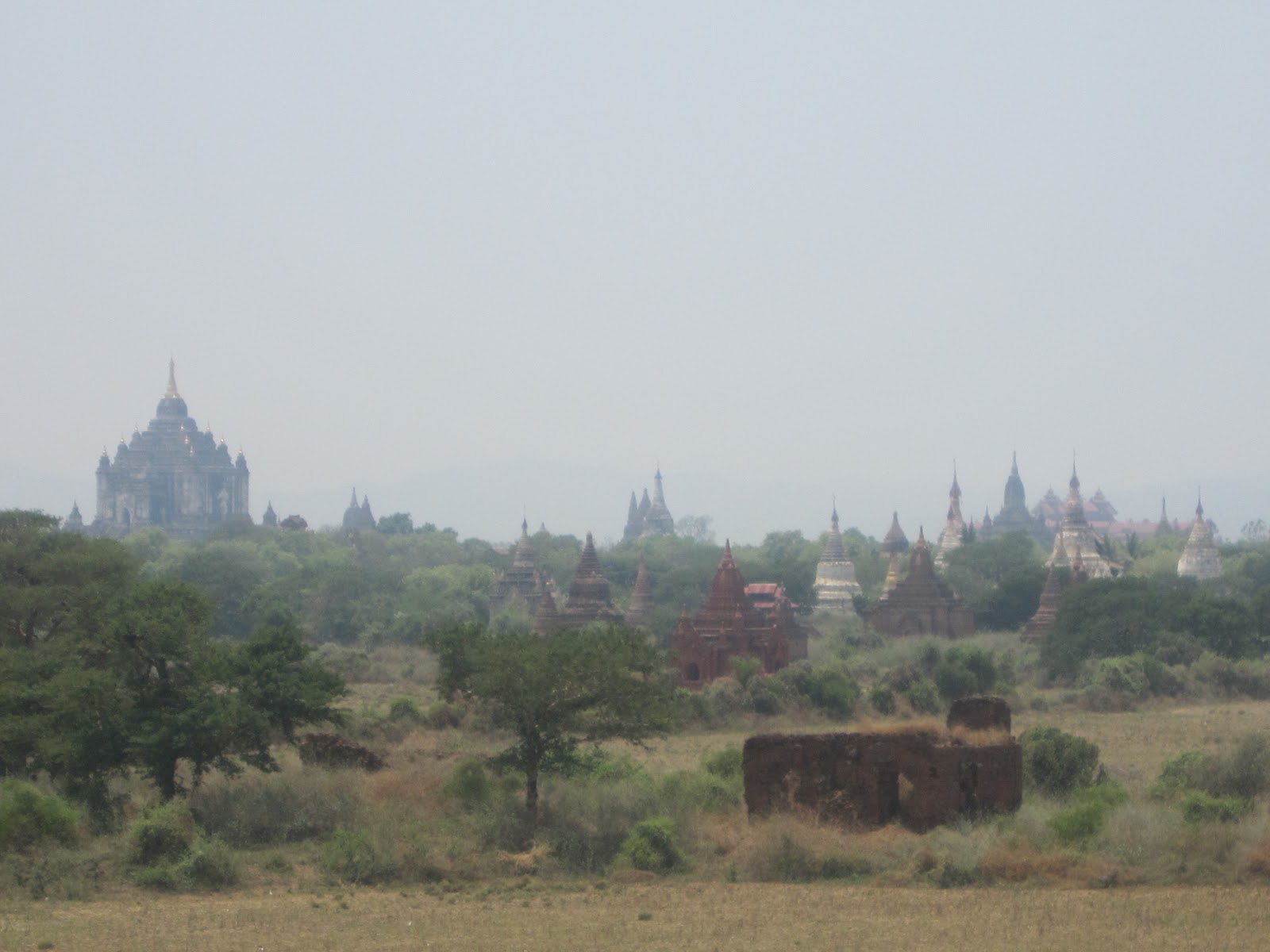
Bagan is an ancient city located in the Mandalay Region of Myanmar/Burma. From the 9th to 13th centuries, the city was the capital of the Kingdom of Pagan, the first kingdom to unify the regions that would later constitute modern Myanmar. During the kingdom's height between the 11th and 13th centuries, over 10,000 Buddhist temples, pagodas and monasteries were constructed in the Bagan plains alone, of which the remains of over 2200 temples and pagodas still survive to present day.

The square temples dominated by Mon influence are distinguished by their dark corridors which are dimly lighted by perforated windows and the bright frescoes of variegated colour with Mon writing on the walls. The typical Bagan Style temples are bright and airy within, with imposing plan and height. But there are also some temples with intermediate forms.


The Shwezigon Phaya (picture below) is a Buddhist temple located in Nyaung-U, a town near Bagan, in Burma/Myanmar. It is a prototype of Burmese stupas, and consists of a circular gold leaf-gilded stupa surrounded by smaller temples and shrines. Construction of the Shwezigon Phaya began during the reign of King Anawrahta and was completed in 1102 AD, during the reign of King Kyansittha of the Pagan Dynasty. The phaya is believed to enshrine a bone and tooth of Gautama Buddha. Within the compound of the Shwezigon Phaya is a stone pillar containing Mon language inscriptions dedicated by King Kyansittha.


Shwezigon Phaya


Built by King Alaungsithu (1113-1163), the Thatbyinnyu is a transitional temple, standing between the Early Style of the Ananda, half a mile to the northeast, and the Late Style of the Gawdawpalin, half a mile to the northwest. It is one of the earliest double-storeyed temples, but the arrangement is different from that of later double-storeyed temples, much as if it were still an experiment in the new form.


Ceiling decorations inside one Phaya


It is possible to travel around Bagan to the different temple sites in horse-drawn carts. You can also hire bicycles and bike around the area on your own.


The Bagan plains has numerous Phayas of various sizes that has survived to this day.


The Ananda Phaya is a Buddhist temple built in 1105 AD during the reign (1084–1113) of King Kyanzittha of the Pagan Dynasty. It is one of four surviving temples in Bagan. The temple layout is in a cruciform with several terraces leading to a small pagoda at the top covered by an umbrella known as hti, which is the name of the umbrella or top ornament found in almost all pagodas in Myanmar/Burma. The Buddhist temple houses four standing Buddhas, each one facing the cardinal direction of East, North, West and South. The temple is said to be an architectural wonder in a fusion of Mon and adopted Indian style of architecture.


Ananda Phaya


Inside the Ananda Phaya


Mahabodhi Tample was modeled after the famous Mahabodhi temple in Bodhgaya, Bihar State, India during AD 500. It commemorates the spot where the Buddha attained enlightenment. This monument was built during the reign of King Nantaungmya (1211 - 34).

The spire, covered in niches which enclose seated Buddha figures, rises from a square block. This monument is different from the common bell shaped ones in Bagan.


Always take of shoes and socks before entering the Phayas


Decorating of lacquerware which is widely sold throughout Bagan.


Sources: Wikipedia and AncientBagan.com
All photos April 2012: © innwa.blogspot.com